
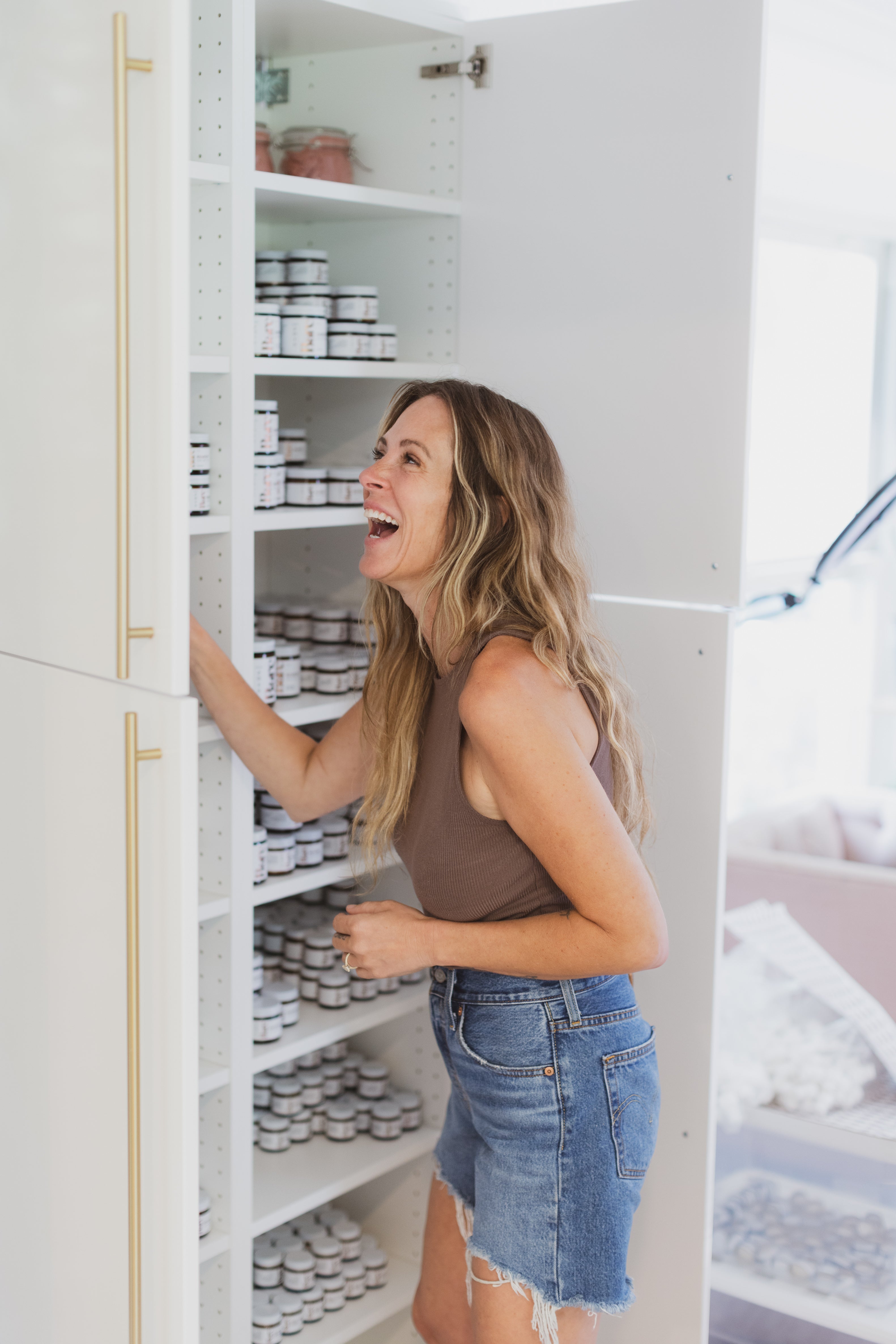
Posted by Jaimie Rae
on May 15, 2026

There is a particular kind of exhaustion that comes from having tried everything.
Not the dramatic kind. Not a breakdown at the bathroom sink. The quiet kind. The kind where you stand in front of a cabinet full of things that almost worked and feel, without being able to name it exactly, tired.
You have done the work. You have read the labels. You have had the phases: the serums, the layering systems, the five-step routines that started as two. You have owned enough moisturizers to know that "deeply hydrating" means almost nothing now. You have bought the beautiful packaging, felt briefly hopeful, and then watched the jar sit half-finished at the back of a shelf for eight months. You have not thrown it away. That would mean admitting something. So it sits.
You are not a beauty failure. You are someone who has been sold too many products.
Building Bare did not start with a product idea. It started with a question.
What would a skincare routine look like if it only included what actually stayed?
Not what sounded good. Not what had the most compelling ingredient list on paper, or the best packaging, or the most convincing story behind it. What stayed. What got used down to the last jar. What made it past the first three weeks and became, quietly and without announcement, just the thing you used.
Most products do not make it there. Most products live in the in-between space: too expensive to throw away, not good enough to keep buying. That is where the cabinet fills up. That is where the exhaustion lives.
The answer, when we kept returning to it honestly, was almost always: fewer things, made better.
The beauty industry is not built on restraint.
It is built on the opposite. On new launches, seasonal newness, limited editions, and the persistent suggestion that what your skin is missing is just one more product away. More serums. More steps. More ways to subdivide the face into problems requiring individual solutions.
This is not a conspiracy. It is simply how the business works. More products, more revenue. More problems named, more solutions sold. The category profits from complexity.
Bare was a response to that. Not a loud one. A quiet one.
The question was never "what else can we add?" The question was "what would be enough?"
Enough is harder to answer than it sounds. It requires knowing what actually works on skin, not just what sounds persuasive in copy. It requires being willing to say no to things that are good but not necessary. It requires trusting the customer to find her own way into a simpler routine, instead of constructing a system so elaborate that she needs you to explain it.
Not more steps. Not louder claims. Just better.
The Bare Edit is four products.
That is the whole routine. Undone, a balm that melts makeup and the day's buildup without stripping the skin. Revive, a daily face balm that gives skin what most routines keep trying to replace. Renew, a body balm made for soft, nourished skin without the weight of a traditional lotion. And Lip Butter, the small jar you will actually finish.
Four things that do the work without requiring a manual, a quiz, or fifteen minutes before you can leave the house.
The restraint in that number was not an accident. It came from a longer, slower process of asking what skin actually needs versus what it has been told it needs. What nourishes versus what simply adds another layer. What a real person reaches for in the morning versus what looks complete on a product grid.
Four products. That is it. When you know what works, you stop looking.
The ingredient at the center of that routine is 100% grass-fed and finished beef tallow.
That sentence still gives some people pause. It does not immediately read as luxury. For years, the beauty industry told us that the more synthesized and lab-engineered an ingredient, the more sophisticated it must be. Tallow is none of those things. It is not synthesized, not novel, not built on a trend cycle.
It is also not crunchy. Not clinical. Not a back-to-nature statement or a natural-beauty manifesto.
It is not miraculous. It does not cure anything. But skin tends to recognize it differently than many modern moisturizers. It absorbs. It settles. It works.
The result is a kind of nourishment that does not feel like adding something. It feels like restoring something.
Less products. Better ones. Starting with an ingredient that actually belongs.
Restraint in product development is harder than abundance.
Adding is easy. The instinct when something is not quite right is to keep working it, layering in new ingredients, new claims, new angles. The instinct when a product line is growing is to expand it, to give people more options, to answer the needs that have not been answered yet with something new.
Saying no to that is genuinely difficult. It means sitting with a product that is almost right and asking whether what it needs is more. It means choosing not to launch something because the existing version does not yet deserve a place on a real person's shelf.
For the women replacing the products they almost used up with the ones they actually finished.
That is the customer Bare is built for. Not the beauty enthusiast who collects. The woman who is tired of collecting.
Less is more, when the less is made better.
That means every product that carries the Bare name has to be worth the reduction. Worth the decision to say no to the twenty other things that could have taken its place. Worth the trust of someone who has already been let down by a cabinet full of almost-right answers.
When you know what works, you stop looking.
Jaimie Rae, Founder, Bare Tallow Co.